
Introduction:
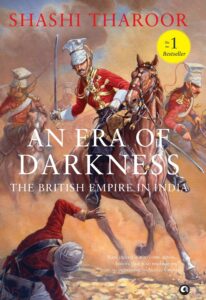
An Era of Darkness is a powerful and unapologetic indictment of British colonialism in India, written by renowned Indian author, historian, and parliamentarian Shashi Tharoor. The book expands upon his viral 2015 speech at the Oxford Union, where he argued passionately for reparations from Britain to India for the centuries of colonial exploitation. In this book, Tharoor systematically dismantles the myth of the “benevolent British Empire” and offers a compelling counter-narrative to the oft-repeated claim that British rule was beneficial for India.
Overview of the Book:
Shashi Tharoor’s central thesis is simple but profound: the British Empire drained India of its wealth, destroyed its industries, manipulated its systems, and left it impoverished and divided. Through a combination of economic data, historical anecdotes, and sharp commentary, Tharoor exposes how the Empire enriched itself while bleeding India dry.
The book is divided into thematic chapters, each dealing with different aspects of colonial rule—economic exploitation, administrative manipulation, racial discrimination, and cultural arrogance. He challenges the popular Western notion that the British brought “modernity” to India in the form of railways, the English language, legal systems, and democracy, arguing instead that these were either side-effects of British self-interest or tools of control.
Key Arguments and Insights:
1. Economic Drain and Deindustrialization:
Tharoor presents a devastating critique of British economic policies that led to the collapse of Indian industry—especially the textile industry—and the systematic extraction of wealth. He cites data from British sources themselves to show how India’s share of global GDP fell from 23% in 1700 to less than 4% by the time the British left in 1947.
2. Famines and Exploitation:
One of the most heart-wrenching aspects of the book is Tharoor’s discussion of recurring famines, especially the Bengal Famine of 1943, where 3–4 million people died. He squarely blames Winston Churchill, stating that grain was exported from India to feed British soldiers while Indians starved. Tharoor argues that such tragedies were not just natural disasters but the direct result of deliberate British policies.
3. Divide and Rule:
The book also explores how the British intentionally sowed divisions between Hindus and Muslims through censuses, separate electorates, and communal policies. Tharoor argues that this laid the groundwork for the tragic Partition of India and the inter-community mistrust that continues even today.
4. The Myth of ‘Good Governance’:
Many claim the British brought law, order, and stable governance to India. Tharoor challenges this view by showing that the British governed only to serve their own economic and strategic interests. Indians were largely excluded from real power, and even reforms like the Indian Civil Service were racially discriminatory and deeply elitist.
5. Railways, English & Institutions – A Double-Edged Sword:
Tharoor does acknowledge that some institutions—like railways and the English language—outlived the British and contributed to modern India’s progress. However, he argues that these were never designed for India’s benefit. The railways were meant to transport raw materials from the interiors to ports for British profit. Similarly, English education was introduced to create a class of intermediaries loyal to the Empire.
6. Cultural Arrogance and Racism:
Another strong section of the book is Tharoor’s critique of British attitudes towards Indians. He describes the racism and cultural superiority with which British officials and writers viewed India—calling Indians lazy, inferior, or barbaric.
He juxtaposes this with India’s ancient and advanced civilizations, knowledge systems, and philosophical traditions that were belittled or destroyed.
Writing Style and Impact:
Tharoor’s writing is characteristically erudite, witty, and sharp. He blends scholarly evidence with persuasive rhetoric, making the book accessible to a general audience. His use of irony and sarcasm is particularly effective in exposing colonial hypocrisy. Despite dealing with dense historical material, the book remains engaging and hard-hitting throughout.
One of the most striking aspects of the book is how Tharoor anticipates and debunks common defenses of colonialism. He systematically addresses the “What about railways?” argument, the “They gave us democracy” claim, and the “Indians were corrupt and chaotic before the British came” myth. This makes the book not just informative, but also a valuable guide in post-colonial discourse.
Criticism and Limitations:
Some critics argue that Tharoor’s tone is occasionally too polemical or one-sided. While the book offers a powerful critique, it sometimes downplays the complexity of Indian society before and during colonial rule. It also lacks detailed citations or footnotes in places, which can make it difficult for readers to verify claims.
However, Tharoor has acknowledged that this book is meant as a popular, not academic, history. For a book aiming to provoke thought and challenge dominant narratives, its passionate tone may be both necessary and justified.
Conclusion:
An Era of Darkness is a bold, unapologetic, and necessary reexamination of colonial history. In an era where colonial nostalgia still lingers in Western discourse, and many Indians continue to see British rule as a “mixed blessing,” Tharoor’s book is a much-needed corrective.
It challenges readers—especially Indians—to reclaim their historical agency and understand the full cost of colonialism. It reminds us that independence wasn’t just a transfer of power, but a reclaiming of dignity, identity, and self-respect.
Highly recommended for students, educators, policymakers, and anyone interested in the truth behind the British Empire in India.
By- Abhishek